By Cook Once. Eat Later. • Updated August 24, 2026
Freezing food isn’t random — and texture doesn’t change by accident. When food enters the freezer, microscopic structural changes begin immediately. Some preserve quality. Others damage it. Understanding what actually happens during freezing gives you control over texture, flavor, and consistency — turning freezer meals from guesswork into a structured system.
Why Freezing Changes Food Texture (Quick Answer)
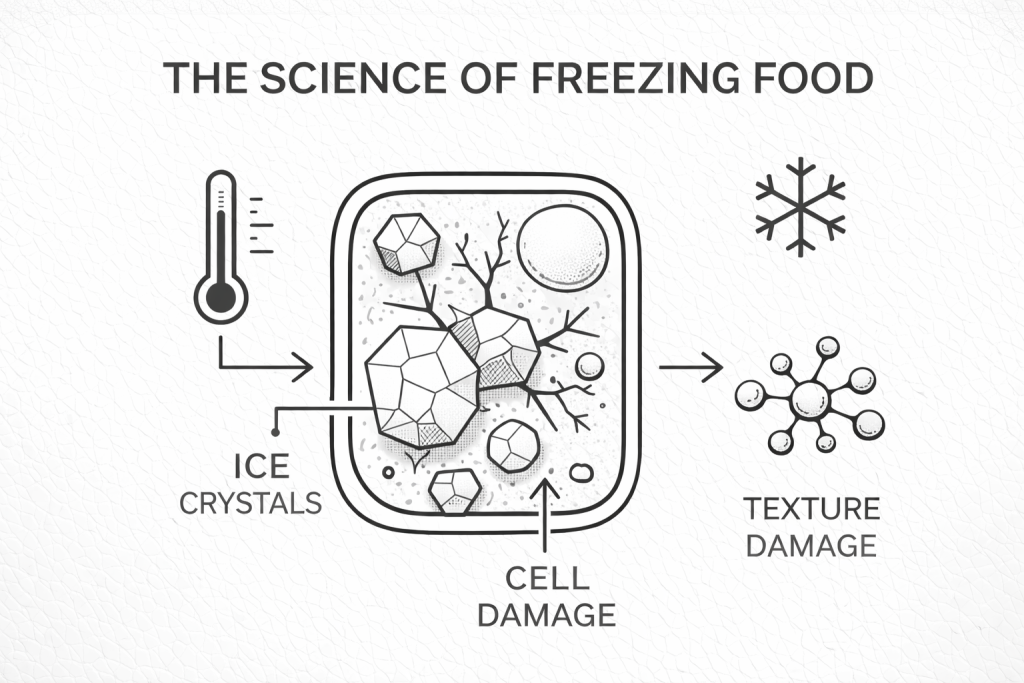
Freezing changes food texture because water inside the food turns into ice and expands, forming ice crystals that damage cell structure. When the food is reheated, this damage causes moisture loss, softness, or separation.
- Ice crystals rupture cell walls and weaken structure
- Slow freezing creates larger crystals and more damage
- Moisture migrates out of the food during freezing
- Reheating releases that moisture as liquid
Texture changes aren’t random — they’re caused by ice crystal formation and moisture movement, both of which can be controlled with proper technique.
Disclosure: This article may contain affiliate links. As an Amazon Associate, I earn from qualifying purchases at no extra cost to you.
Freezing Food Understood
Freezing isn’t unpredictable, and texture doesn’t change by coincidence. When food freezes, microscopic shifts occur inside its structure. Some of those shifts help preserve food. Others compromise it.
Understanding what happens during freezing — and why — allows you to prevent most common freezer meal problems. Once you understand the science, you stop reacting to issues like mushy vegetables or watery reheats. You start preventing them.
Freezer meals aren’t ruined by the freezer.
They’re affected by physics.
Don’t feel like reading? Press play and watch below.
What Happens When Food Freezes
Food is largely made up of water. Some foods contain more than others, but nearly all fresh ingredients rely on water for structure and texture.
When food freezes, the water inside turns into ice.
Here’s the critical detail: water expands as it freezes.
As it expands, it forms ice crystals that push against and rupture cell walls. When those cell walls are damaged, the food loses structural integrity. That’s why thawed vegetables can become soft and why proteins often release excess liquid during reheating.
Freezing speed also plays a major role. Rapid freezing produces smaller ice crystals, which cause less structural damage. Slow freezing creates larger crystals that break down more of the food’s internal structure.
Texture loss isn’t mysterious.
It’s mechanical.
Why Some Foods Survive Freezing Better Than Others
Some foods tolerate freezing far better than others. The reason comes down to composition and structure.
High-water foods are more vulnerable. The more water present, the more expansion occurs during freezing — and the greater the structural damage.
Fat plays a protective role. In proteins, fat reduces overall water concentration and acts as a buffer during freezing. That’s why well-marbled meats often reheat better than ultra-lean cuts.
Starches help as well. Rice, potatoes, and grains can absorb and redistribute moisture, reducing separation during reheating. Fiber-dense vegetables also tend to hold structure better because their cell walls are naturally stronger.
Freezing performance isn’t about luck.
It’s about composition.
Moisture Migration (The Hidden Factor)
Moisture migration is one of the least understood — and most important — aspects of freezing food.
There are two types:
Internal migration — moisture moving between components within the food itself.
External migration — moisture moving between the food and its surrounding environment.
For freezer meals, external migration is the greater concern.
When food enters the freezer, water naturally moves toward colder surfaces. As it reaches the surface, it freezes and forms frost or ice crystals. This is moisture leaving the internal structure of the food.
Cooling food completely before freezing is critical. If food is still warm, it releases steam inside the container. That steam turns into condensation, which then freezes into ice. More ice means more structural damage.
When reheated, that migrated moisture melts. It doesn’t reintegrate neatly into the food’s structure — it pools at the bottom of the container, diluting flavor and weakening texture.
Moisture migration isn’t random, it’s movement that can be controlled.
Temperature Stability Matters
Temperature fluctuations inside your freezer can worsen texture damage.
If food partially thaws and refreezes, ice crystals grow larger. Larger crystals cause more structural breakdown. This is why repeated thaw/refreeze cycles are especially damaging.
Keeping meals stored toward the back of the freezer — where temperatures remain most stable — reduces these fluctuations and limits ice crystal growth.
Consistency protects structure.
How to Control Texture (Your System Applied)
Texture control doesn’t start in the freezer.
It begins before the food is cooked — and continues through reheating.
When you understand the science, you realize something important: freezing doesn’t ruin food. Lack of control does.
Here’s how to apply structure at every stage:
Shopping: Start With Strong Ingredients
Fresh ingredients are structurally intact. As food ages, natural enzymatic breakdown begins. Freezing weaker ingredients accelerates texture loss.
Strong structure starts at the store with shopping for the best ingredients.
Cooking: Build Structure, Don’t Destroy It
Cooking technique determines how well food survives freezing.
• Strategic undercooking prevents over-softening during reheating.
• Browning proteins through the Maillard reaction builds flavor and reinforces structure.
• Thick, properly reduced sauces protect food from moisture loss.
You’re not cooking for the plate, you’re cooking for the freezer.
Proper Cooling: Stop Moisture Before It Moves
Cooling fully before freezing prevents condensation inside your container. It slows moisture migration and reduces ice crystal formation.
When you cool properly, you eliminate many problems before they begin.
Container Structure: Control Air Exposure
Air exposure accelerates dehydration, this is why using the right container is essential.
A properly sized container:
• Minimizes headspace
• Limits cold air contact
• Supports faster freezing
• Reduces crystal growth
Structure matters as much as ingredients.
View the exact container I use here.
Reheating: Finish With Intention
Reheating is your final opportunity for control and needs to be done right.
• Start with the lid partially on to create controlled steam
• Stir halfway through when possible
• Finish with the lid off to remove excess moisture
You’re not just warming food, you’re completing the cooking process.
Stop guessing. Build freezer meals that freeze and reheat perfectly.
Common Myths About Freezing
Freezer meals are often misunderstood.
You may have heard:
• “Freezing ruins texture.”
• “Freezer burn makes food unsafe.”
• “It’s too complicated to do properly.”
These concerns can feel true when freezing is done without structure, but freezing itself isn’t the problem. Freezer burn affects quality, not safety and texture changes are predictable. The process becomes simple once you understand what’s happening beneath the surface.
Freezing isn’t guesswork, it’s controlled science.
Final Thoughts
Freezing food is science.
Texture change is predictable.
Quality loss is preventable.
When you understand what freezing does, you stop guessing. Freezer meals don’t fail because of the freezer. They fail because of preparation.
Cook with structure.
Freeze with control.
Reheat with intention.
Don’t feel like reading? Press play below to listen.
Looking for the tools behind this system?
View Recommended Tools
About the Author
Here at Cook Once Eat Later we share freezer meal recipes, meal prep systems, and practical freezing guides designed to help busy people save time without sacrificing flavor. Our focus is helping meals retain their texture, moisture, and quality long after they’ve been frozen.
Follow Cook Once Eat Later on Instagram for freezer meal tips, recipes, and meal prep inspiration.
FAQ
Why does freezing change food texture?
Freezing changes texture because water inside food turns into ice and expands. This creates ice crystals that damage cell walls, causing softness, moisture loss, and structural breakdown after thawing.
What causes ice crystals in frozen food?
Ice crystals form when water freezes and migrates toward colder areas. Slow freezing and temperature fluctuations create larger crystals, which lead to more texture damage.
Why do frozen meals release water when reheated?
Water released during reheating comes from damaged cell structures and moisture migration. As ice melts, it separates from the food instead of reintegrating, leading to pooling liquid.
Does freezing food ruin it?
No. Freezing does not ruin food — improper preparation and storage do. When done correctly, freezing preserves both quality and safety.
What foods freeze the best?
Foods with lower water content, higher fat, or strong structural integrity freeze best. This includes meats, rice, pasta, and dense vegetables.
How can I prevent texture loss when freezing food?
You can reduce texture loss by:
• Cooling food completely before freezing
• Using airtight containers
• Using a proper sauce
• Freezing quickly
• Reheating with controlled moisture